
Telemetry and hours-of-service auditing: exception triage with AI support
Telemetry and hours-of-service records already exist; reviewing them by hand does not scale. How to cross sources and build an exception queue.
Mauricio Zaffari
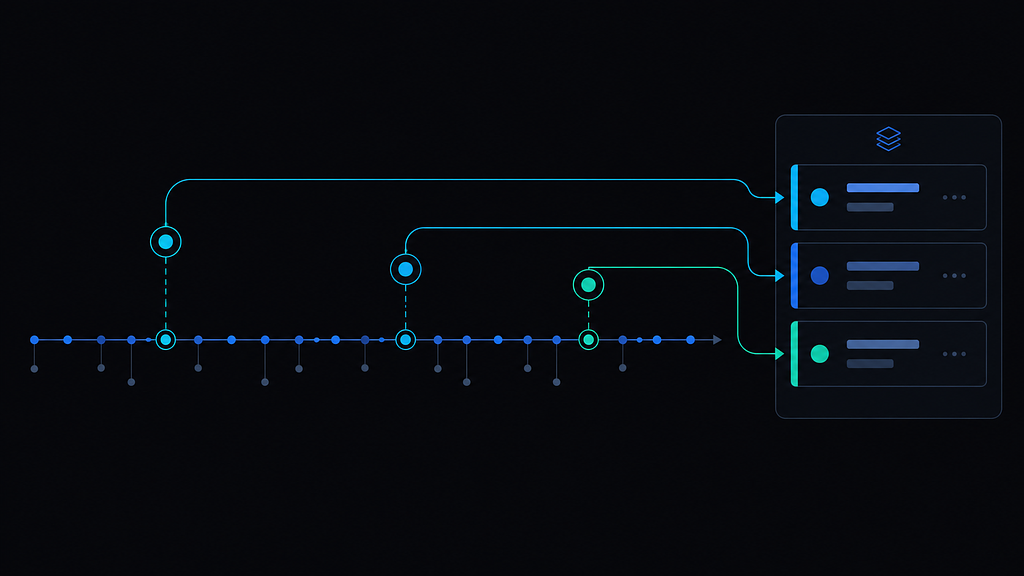
Consider an example scene. At 14:10, the tracker on one truck reports movement. The hours-of-service record says the break ran until 14:40. The vehicle moves during a recorded break; that deserves a check of the shift schedule and the records before any conclusion. Nobody notices, because nobody is looking at both screens at once.
That is the whole problem in one scene. Without comparing the records, the gap may go unnoticed until it becomes a complaint, a cost or an incident. Here is how the comparison reaches a review queue.
What the scene is made of
Zoom out for a moment. The telemetry platform stores position, speed, stops and ignition events. The hours-of-service system keeps the start, the breaks and the end of each shift. Two systems, two keys, two clocks that do not always agree.
The systems already record the events; comparing the records by hand takes staff time. In a mid-sized fleet, that turns into a pile of reports nobody opens until something goes wrong, and the audit happens only by exception: a customer complains, a cost rises, an incident appears, and someone goes back to rebuild what happened.
Crossing the two sources
The first job is defining what ties the two systems together. Most of the time it is the combination of vehicle and time window; the shift schedule suggests the driver on duty.
Before comparing, normalize the timestamps to a single reference. The two systems may use different time zones and different rounding, and without normalization a good part of the divergences is just measurement noise.
Then the crossing itself. Telemetry marks movement at 14:10. The hours-of-service record shows the restart at 14:40. Marked: a candidate 30-minute divergence on that vehicle, on that shift. You do not have to resolve every divergence at once. It is enough to mark where they appear.
flowchart TD
    A["Telemetry marks movement at 14:10"] --> C["30-minute divergence"]
    B["Hours of service records restart at 14:40"] --> C
    C --> R{"Business rule and threshold"}
    R --> D["Exception for review"]
    D --> E["Analysis queue by business criteria"]
    E --> F["Human review"]
The rule decides, not the data
A time divergence on its own may mean nothing. Thirty extra minutes can be a logging mistake or unrecorded work. What decides it is not the data, it is the business rule. A few criteria that show up in fleet operations:
- a stop outside an authorized point beyond a given time;
- movement with no active hours-of-service record;
- an active record with no movement for long periods;
- speed above the road limit.
Each criterion produces a type of exception with a different weight. The thresholds do not have to be perfect in the first version: they start from a baseline and get adjusted as the team sees what reaches the queue. A threshold set too low floods the queue; set too high, it may miss relevant cases.
In one possible design, AI supports this step in two ways: it groups similar exceptions so each case is not treated as unique, and it suggests an initial reading for each group, which the team confirms or corrects. The criterion still belongs to the company. The support is in triage, not in the decision.
Back to the truck
Return to the 14:10 divergence. With the rules in place, it enters the queue for comparison, with the telemetry excerpt, the hours-of-service record and the candidate rule attached.
An analyst looks at it and decides what it is: a data error, a process failure, or something that needs handling. Say the driver logged the break by hand at the end, from memory. The case closes as a logging error, and the finding is recorded so the team can review the rule before the next round of triage.
The queue is ordered by business impact, higher-impact exceptions at the top, low-risk ones grouped and checked by sampling. Human review is not an optional step: it is where the process earns trust. Logging the decision on each case is what lets you review the rules weeks later.
What to measure once the loop runs
Without measurement, the queue becomes one more report nobody uses. A few indicators that often make sense:
- how many exceptions were flagged and how many were analyzed;
- average time between the occurrence and the analysis;
- how many exceptions were classified as false positives;
- how many cases were resolved without escalating to another area.
These numbers do not prove a return. They show whether triage is working and where it needs adjustment. Return is a hypothesis you evaluate later, with the process in use.
In summary
Telemetry and hours-of-service data already exist. What does not scale is reading all of it by hand. Normalize the clocks, cross the sources by vehicle and time window, mark the divergences, and let business rules decide what becomes an exception. Then put an analysis queue and a named reviewer in front of it. That is the path to seeing the 14:10 case before it becomes a complaint, without replacing your current systems.
If this is a process worth evaluating in your operation, the diagnostic is usually planned for 2 to 3 weeks. A pilot, when it makes sense, is estimated at 4 to 6 weeks after the scope is defined. Want to start? Request a diagnostic.